what happens to investment if the cb changes the interest rate equation
This is the process through which monetary policy decisions affect the economy in general and the price level in particular. The transmission machinery is characterised past long, variable and uncertain time lags. Thus it is difficult to predict the precise effect of monetary policy actions on the economy and cost level.
The nautical chart below provides a schematic illustration of the main transmission channels of monetary policy decisions.
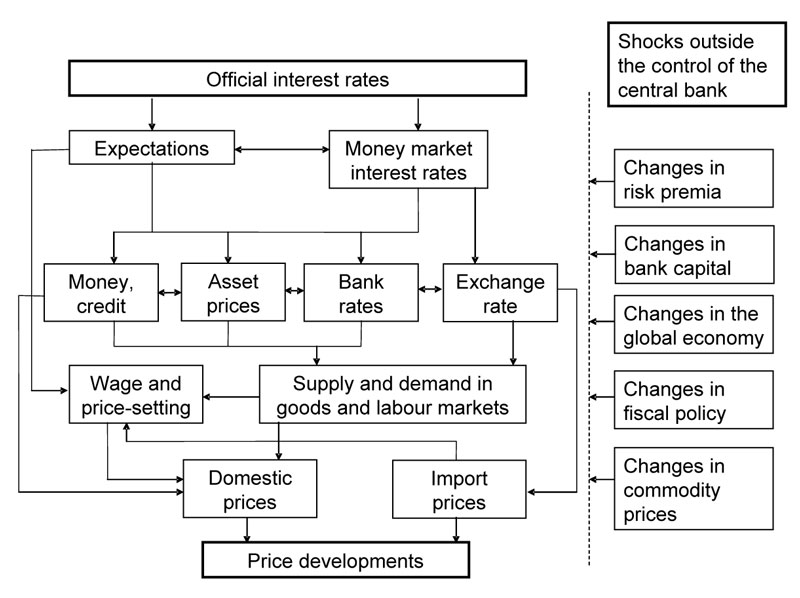
Change in official interest rates
The fundamental banking company provides funds to the banking system and charges involvement. Given its monopoly power over the issuing of coin, the central bank tin can fully determine this interest rate.
Affects banks and money-market place involvement rates
The change in the official interest rates affects directly money-market interest rates and, indirectly, lending and eolith rates, which are set past banks to their customers.
Affects expectations
Expectations of hereafter official interest-charge per unit changes impact medium and long-term interest rates. In particular, longer-term interest rates depend in part on market expectations most the future course of short-term rates.
Budgetary policy can likewise guide economic agents' expectations of future aggrandizement and thus influence toll developments. A cardinal bank with a high degree of credibility firmly anchors expectations of toll stability. In this case, economic agents do not take to increase their prices for fear of higher aggrandizement or reduce them for fearfulness of deflation.
Affects asset prices
The impact on financing conditions in the economy and on marketplace expectations triggered past monetary policy actions may lead to adjustments in asset prices (e.g. stock market prices) and the exchange rate. Changes in the commutation rate can affect inflation directly, insofar as imported appurtenances are directly used in consumption, simply they may as well piece of work through other channels.
Affects saving and investment decisions
Changes in interest rates affect saving and investment decisions of households and firms. For example, everything else being equal, college interest rates make it less attractive to take out loans for financing consumption or investment.
In addition, consumption and investment are also afflicted past movements in asset prices via wealth effects and effects on the value of collateral. For case, as equity prices ascent, share-owning households become wealthier and may choose to increase their consumption. Conversely, when equity prices fall, households may reduce consumption.
Nugget prices can as well have impact on aggregate demand via the value of collateral that allows borrowers to get more loans and/or to reduce the risk premia demanded past lenders/banks.
Affects the supply of credit
For example, college involvement rates increase the risk of borrowers being unable to pay back their loans. Banks may cut back on the corporeality of funds they lend to households and firms. This may too reduce the consumption and investment by households and firms respectively.
Leads to changes in amass demand and prices
Changes in consumption and investment will change the level of domestic demand for goods and services relative to domestic supply. When demand exceeds supply, upwardly cost pressure is likely to occur. In addition, changes in aggregate need may interpret into tighter or looser conditions in labour and intermediate product markets. This in turn tin can affect price and wage-setting in the respective market place.
Affects the supply of bank loans
Changes in policy rates tin affect banks' marginal cost for obtaining external finance differently, depending on the level of a bank'south own resources, or banking company upper-case letter. This channel is particularly relevant in bad times such as a fiscal crisis, when capital is scarcer and banks detect it more than hard to raise capital.
In addition to the traditional banking company lending channel, which focuses on the quantity of loans supplied, a run a risk-taking channel may exist when banks' incentive to acquit take chances related to the provision of loans is affected. The chance-taking channel is thought to operate mainly via two mechanisms. First, low interest rates heave nugget and collateral values. This, in conjunction with the belief that the increase in asset values is sustainable, leads both borrowers and banks to accept higher risks. Second, depression interest rates make riskier avails more bonny, as agents search for higher yields. In the instance of banks, these two effects usually translate into a softening of credit standards, which can lead to an excessive increment in loan supply.
All pages in this department
comstockorout1950.blogspot.com
Source: https://www.ecb.europa.eu/mopo/intro/transmission/html/index.en.html
0 Response to "what happens to investment if the cb changes the interest rate equation"
Post a Comment